The Shoulder That Breathes
On spalla camicia, Naples, and the particular Italian understanding that ease is not the enemy of elegance
There is a moment — if you have ever tried on a jacket made in Naples, or been fortunate enough to stand near someone wearing one — when you understand something about the Italian relationship with clothing that photographs and descriptions never quite capture.
The jacket moves. Not in the way that all jackets move when the person inside them moves. It moves with a kind of consent. As if the garment had considered the body wearing it and decided, at the shoulder specifically, to simply follow rather than lead.
This is not an accident. It is a construction decision — one that was made, refined, and eventually perfected over generations in the tailoring workshops of Naples. It has a name. It is called spalla camicia. It translates, rather beautifully, to shirt shoulder.
And it is one of the most misunderstood things in tailoring.
Let us start with what it actually is, because the technical reality is both simpler and stranger than most people expect.
In conventional tailoring — British tailoring most explicitly — the sleeve is set into the armhole with structure. Padding beneath the shoulder. A raised, roped sleeve head that holds its shape regardless of what the body inside the jacket is doing. The shoulder announces itself. It holds a line. It says: this is where the jacket ends and the arm begins, and that boundary is non-negotiable.
Spalla camicia is the antithesis of this. The sleeve is attached to the armhole without padding and with minimal structure, creating a natural, unforced drape. It is the antithesis of the roped shoulder: where British tailoring asserts structure, spalla camicia asserts ease.
The technical execution is counterintuitive. The sleeve is cut larger than the armhole it is being sewn into — a counterintuitive technique resulting in a series of small pleats or puckers where the sleeve meets the shoulder. These pleats — called grinze in Italian — are the visual signature of the technique. The slight puckering at the sleeve insertion is its defining visual signature. The puckering is not a defect — it is the mark of the technique.
This is where the misunderstanding lives. Almost everyone who encounters spalla camicia for the first time — who has been trained by decades of structured shoulders to read a smooth, unbroken shoulder line as quality — looks at those small ripples and sees imperfection. Sees something that went wrong. Sees the kind of thing that gets returned.
It went exactly right. What looks like a mistake is the evidence that a human hand did this, deliberately, and knew what they were doing.
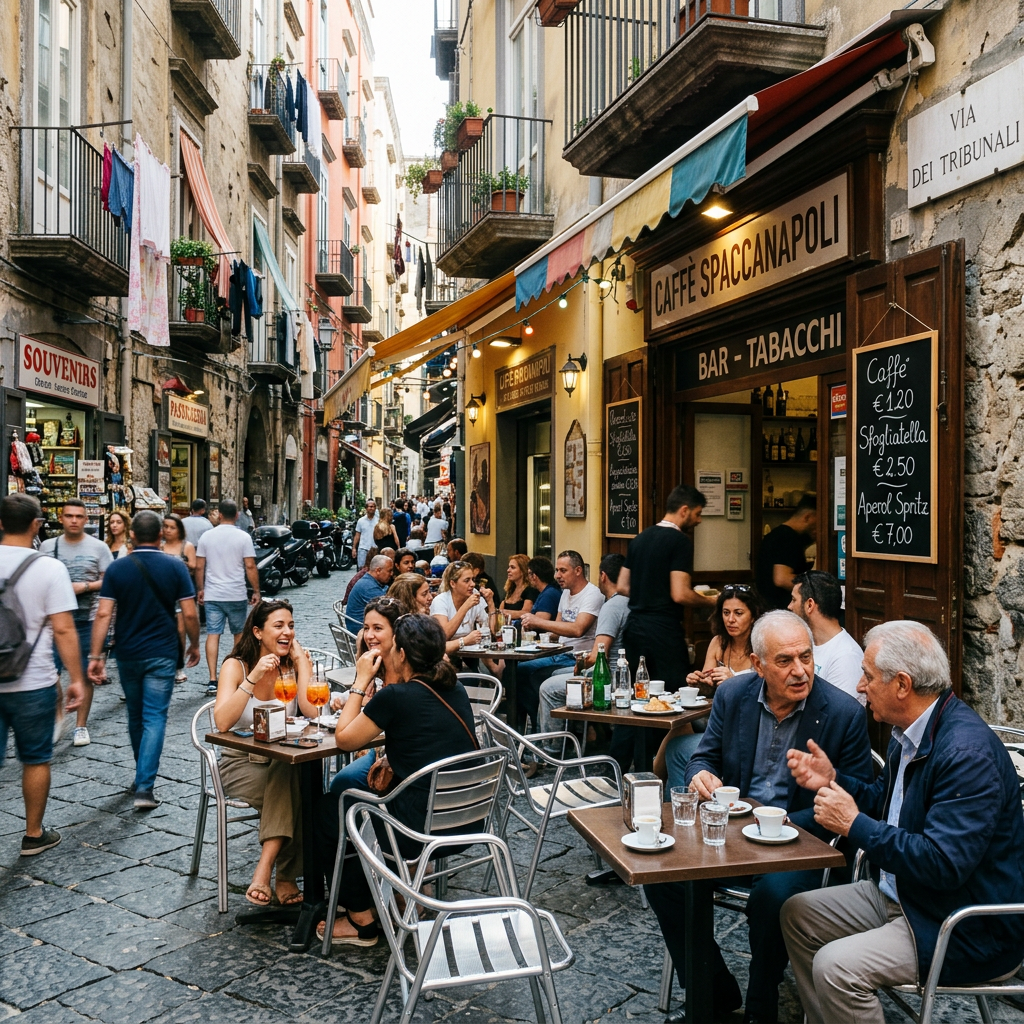
Naples has been making clothes since the 14th century. The roots of Neapolitan tailoring stretch back almost 700 years, to the founding in the 14th century of Italy’s oldest tailoring association, the Brotherhood of the Jacket Makers and of the Tailors. Seven hundred years of people thinking carefully about how cloth should sit on a body in a city where the weather is warm, the streets are alive, and nobody has ever particularly valued the kind of stiffness that announces itself from across a room.
Neapolitan tailoring did not develop the spalla camicia because it lacked the technical ability to do something more structured. It developed it because it had a different idea about what a jacket was for. Neapolitan tailors removed the shoulder padding from their jackets to provide more movement freedom. Not because padding is wrong, but because in Naples — where a jacket might be worn to lunch, to a walk along the waterfront, to an afternoon that becomes an evening without anyone having planned for it — the jacket needed to be a companion rather than a costume.
This is the Italian room from the Four Rooms conversation. The understanding that ease is not the absence of construction but its highest expression. That a garment which follows the body is not a lesser garment than one which shapes it — it is a more sophisticated one, because it requires the construction to be invisible rather than assertive.
The spalla camicia is invisible in exactly this way. You do not notice it when it is working. You notice only that the jacket fits differently from other jackets — that it moves when you move, that raising your arm does not pull the whole garment out of alignment, that you forget, eventually, that you are wearing a jacket at all. That forgetting is the achievement.
The misunderstanding about the grinze — those small ripples — is worth addressing directly because it has consequences.
People see the puckering and assume it means the jacket does not fit. They assume it means the tailor made an error in the sleeve setting. They assume it is the kind of thing that gets fixed in alterations. It is none of these things. The puckering — shirring known as grinze — is something the tailoring dilettante may view as imperfection, but the aficionado appreciates for its magnificent craftsmanship and dégagé beauty.
Dégagé. The French word that means unconstrained, relaxed, free — but in the specifically French sense that implies this freedom is the result of great discipline rather than its absence. It is the quality that makes something look effortless precisely because enormous effort went into making it so.
The grinze are the evidence of that effort. They are what hand-setting a sleeve looks like when it is done correctly. A machine-set sleeve has no grinze because a machine cannot perform the specific manual technique that produces them. Which means that a jacket with perfect, smooth, unbroken shoulders was either made with padding that hides the seam, or it was made by a machine, or both. The ripples are the proof of the hand. The hand is the point.
There is one genuine limitation worth naming, because Marlowe does not believe in withholding useful information in the name of making things sound better than they are.
Because of its pleated shoulder and relaxed construction, spalla camicia is inherently casual. It excels in softly tailored jackets but is generally not the best choice for highly formal occasions, where cleaner, sharper shoulders are preferred.
This is true. The spalla camicia is a jacket for living in, not for standing at attention in. It is the shoulder of a lunch that becomes a walk that becomes a conversation on someone’s terrace as the light changes. It is not the shoulder of the institution, the formal occasion, the room where everyone is performing their seriousness for each other.
For that room, the British roped shoulder does its job better. There is a reason both traditions exist and a reason both have survived. The question is simply which room you are dressing for.
Most rooms, most of the time, are the Neapolitan kind.
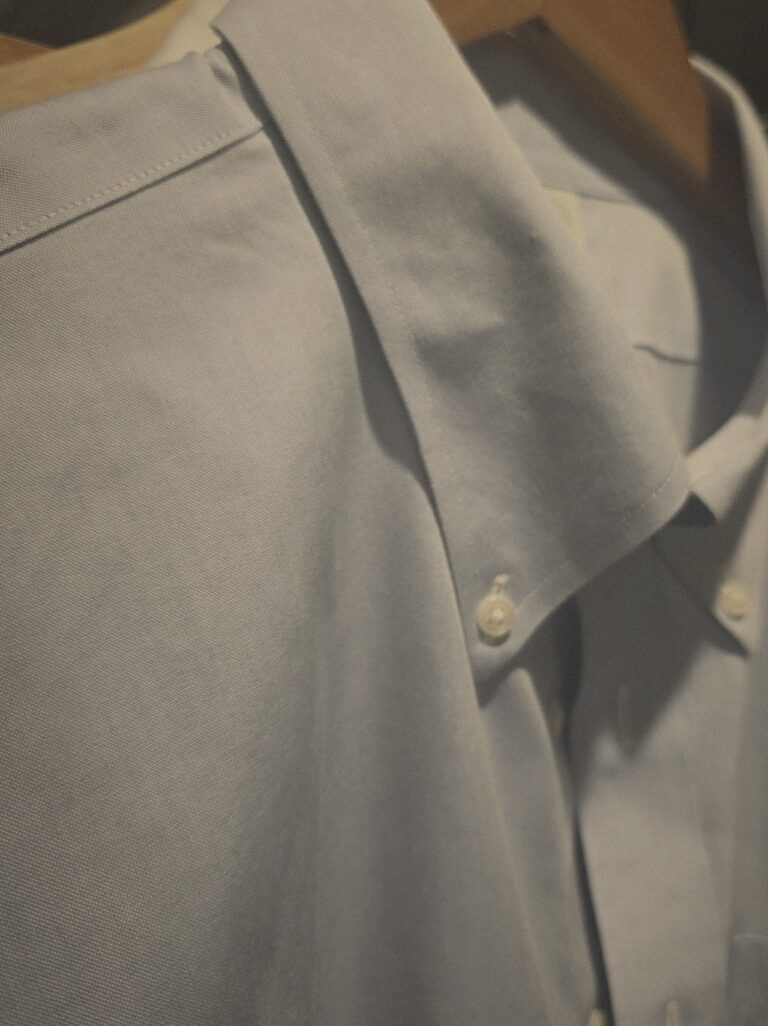
The spalla camicia arrived in shirting — in the construction of actual shirts, not just jackets — through the same logic it arrived everywhere else in Neapolitan tailoring. The shirt sleeve, attached without padding, following the shoulder rather than defining it. The same ease, the same movement, the same quality of a garment that has decided to be on your side.
It is a harder thing to execute in a shirt than in a jacket, for reasons that are technical and not worth exhausting here. What matters is the result — a shirt that moves at the shoulder the way shirts almost never move at the shoulder. That does not pull when you reach. That does not bunch when you sit. That does not remind you, with every gesture, that you are wearing something.
That forgetting, again. The highest compliment a garment can receive.
Marlowe.