The Last Buttonhole
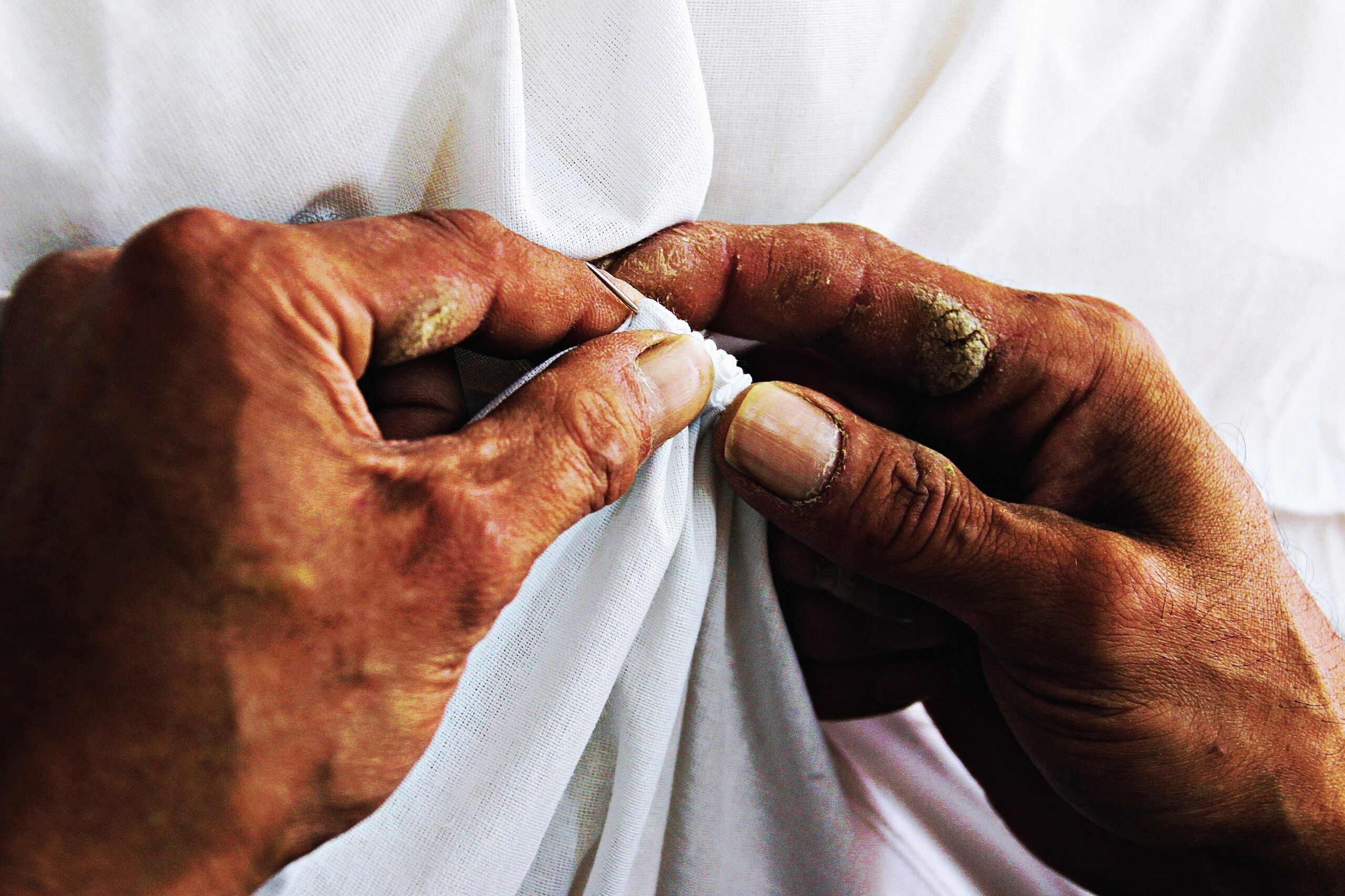
Somewhere in Paris, above a pharmacy or behind a door with no sign on it, someone is sitting under a lamp with a length of silk thread and a small piece of gimp cord.
They are making a buttonhole. Not any buttonhole. One buttonhole. The one on the lapel — the one that will never be used, that exists purely as a declaration of something. A small loop of silk, raised off the fabric, wrapped with a tension so precise that the finished thing looks less like a fastening and more like a piece of jewelry. It is called the Milanese buttonhole. It takes three hours. Sometimes more.
The name has nothing to do with Milan. The gimp cord — a thick, stiff cord around which fine silk thread is wrapped — was once marketed under the name “La Milanese,” and the name stuck. The technique became associated with the great Parisian bespoke houses and certain tailors in Rome. Domenico Caraceni, who studied Savile Row before developing his own method, published a treatise on the style in 1933. His brother took it to Paris. And there, mostly, it stayed.
It is a buttonhole that does not fasten anything. It lives on the lapel — the one place on a garment where it will be noticed only by someone who knows to look. The functional buttonholes elsewhere on the jacket are finished differently, more modestly. The Milanese is too delicate for daily use. What it demonstrates, instead, is that the tailor knew how to do this. And chose to.
There are machines that make buttonholes. They are extraordinary things — capable of producing hundreds of identical stitches a minute, each one consistent, each one reliable. The finished result is, to most eyes, indistinguishable from the handmade version.
Most eyes.
The difference between a machine buttonhole and a Milanese is the difference between a photograph of a garden and a garden. One is a record. The other is a thing that grew. The variations in a hand-stitched buttonhole — the slight adjustments in tension, the small decisions made a hundred times over three hours — are not imperfections. They are the signature of someone who was there, doing the work, making choices no algorithm was directing.
That knowledge — how to make this thing, how to hold the thread, how to feel when the tension is right — lives entirely in hands. It passes from one person to another, through years of watching and doing. There is no manual. No shortcut. And when the person who holds it stops working, that version of the knowledge goes with them.
This is happening quietly, in workshops in Paris and Rome and on streets whose names most people will never know. The Milanese buttonhole is going the way things go when the world stops finding them worth the time they take. Not all at once. Not with any announcement. Gradually, one retirement at a time.
What stays, for now, is the object itself. The raised cord. The invisible knot at the end. The lapel of a jacket made by someone who spent an afternoon on a single detail that most people will walk past without noticing.
There is something in that — the choosing to do a thing properly when no one is requiring it of you — that feels worth paying attention to. Not as nostalgia. Just as a reminder that some things are worth the time they take, and that the difference between careful and careless is not always visible. But it is always there.
Somewhere in Paris, under a lamp, someone is still making this choice. Three hours. One buttonhole. Silk thread on a gimp cord.
It is, in its quiet way, exactly right.
Marlowe.